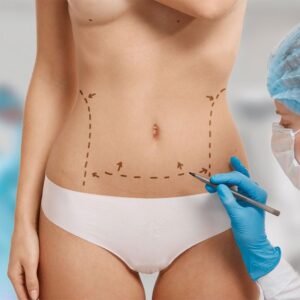
Not all fat behaves the same way. Fat in the back, male chest, upper abdomen, and areas of previous liposuction is often denser and more fibrous than fat elsewhere on the body, making it harder to remove with conventional suction alone. Ultrasound-assisted liposuction (UAL) was developed specifically to address this challenge. At Aakar Aesthetics, Dr. Kiran Nerkar offers ultrasound-assisted liposuction in Nashik as an advanced option for patients whose fat composition calls for a more targeted approach.
This page explains how ultrasound-assisted liposuction works, who benefits most from it, and how it compares with other liposuction techniques available at our clinic.
What Is Ultrasound-Assisted Liposuction?
Ultrasound-assisted liposuction is a body-contouring technique that uses ultrasonic energy to liquefy fat cells before they are removed from the body. Unlike traditional liposuction, which relies purely on the mechanical motion of a cannula to break up and dislodge fat, UAL introduces a probe that emits high-frequency sound waves. These sound waves cause fat cell membranes to rupture, essentially turning solid fat into a liquid emulsion that can then be suctioned out far more easily.
This technology makes UAL especially valuable in fibrous, dense areas of the body where fat has a tougher, more connective-tissue-rich structure — areas that can be difficult and physically demanding to treat with suction-assisted liposuction alone.
How the Ultrasound-Assisted Liposuction Procedure Works
-
Consultation and Assessment
Dr. Kiran Nerkar evaluates the treatment areas, fat consistency, and skin quality to determine whether ultrasound-assisted liposuction is the right choice, or whether it should be combined with another technique such as the tumescent method.
-
Tumescent Fluid Infusion
As with most modern liposuction procedures, a tumescent solution — a mixture of saline, local anesthetic, and a vessel-constricting medication — is infused into the treatment area first. This reduces bleeding, numbs the tissue, and prepares it for the ultrasound stage.
-
Ultrasonic Energy Application
A specialised probe is inserted through a small incision and delivers ultrasonic energy directly into the fat layer. This energy liquefies the fat cells while leaving surrounding structures such as blood vessels, nerves, and connective tissue relatively undisturbed.
-
Fat Removal
Once the fat has been emulsified, it is removed using a standard suction cannula. Because the fat is already liquefied, this stage typically requires less physical force than traditional liposuction, which can also translate to less trauma to the surrounding tissue.
-
Skin Assessment and Closure
Small incisions are closed, and a compression garment is fitted to support the treated area during initial healing.
-
Recovery
Most patients go home the same day. Some post-procedure swelling, mild bruising, and firmness are expected as the body adjusts.
Key Benefits of Ultrasound-Assisted Liposuction
- Effective on Fibrous, Dense Fat: UAL is particularly well suited for areas such as the male chest (including gynecomastia), upper back, and areas being re-treated after previous liposuction.
- Reduced Physical Trauma to Tissue: Because fat is liquefied before removal, less mechanical force is needed during suction, which can mean gentler treatment of the surrounding tissue.
- Precision in Difficult Areas: The technology allows for more controlled sculpting in anatomically complex or previously scarred areas.
- Can Improve Skin Retraction: Some patients experience a degree of skin tightening as a secondary benefit, although UAL is not primarily a skin-tightening procedure.
- Often Combined with Other Techniques: UAL is frequently used alongside tumescent or power-assisted liposuction to achieve the best overall results for a patient’s specific anatomy.
Areas of the Body Best Suited for Ultrasound-Assisted Liposuction
- Male chest (gynecomastia)
- Upper and lower back
- Flanks and love handles in patients with dense fat
- Areas of secondary or revision liposuction
- Upper abdomen in select patients
While UAL can be used across the body, it delivers its greatest advantage in areas where fat is notably fibrous or where previous fat-removal procedures have left scar tissue that is harder to treat with standard suction alone.
Am I a Good Candidate for Ultrasound-Assisted Liposuction?
You may be a good candidate for UAL if you:
- Have localized fat in fibrous or dense areas such as the chest or back
- Are seeking revision liposuction after a previous procedure
- Are within a healthy weight range with realistic expectations
- Have good skin elasticity
- Do not smoke, or are willing to stop well before and after surgery
- Are in good overall health with no conditions that would increase surgical risk
Dr. Kiran Nerkar will assess your fat distribution and tissue quality during a personal consultation to confirm whether UAL — alone or combined with tumescent liposuction — is the ideal approach for your goals.
Recovery After Ultrasound-Assisted Liposuction
-
First 48–72 Hours:
Expect swelling, bruising, and firmness in the treated area. Compression garments should be worn as directed.
-
Week 1
Light activities can usually resume within a few days, though strenuous exercise should be avoided.
-
Weeks 2–4
Swelling gradually decreases, and the treated area begins to show a smoother contour.
-
Weeks 4–6
Most patients can gradually return to full exercise routines, pending surgeon clearance.
-
3–6 Months
Final results become apparent as all residual inflammation resolves and the skin fully settles over the new contour.
Because UAL can generate mild heat at the probe tip, your surgeon will take care to monitor treatment carefully to minimise the risk of thermal injury to the skin — a key reason why choosing an experienced, trained surgeon matters for this technique.
Ultrasound-Assisted Liposuction vs. Other Techniques
UAL vs. Tumescent Liposuction:
Tumescent liposuction is the foundational fluid-infusion technique used in nearly all modern liposuction procedures, including UAL. UAL adds an extra step — ultrasonic fat liquefaction — that is particularly useful for dense or fibrous tissue that plain tumescent suction may struggle to remove efficiently.
UAL vs. Laser-Assisted Liposuction (LAL):
Both technologies use energy to help break down fat, but LAL uses laser energy (which also stimulates collagen for some skin tightening), while UAL uses ultrasonic sound waves. UAL tends to be more effective in dense, fibrous areas, while LAL is often chosen for smaller, more delicate zones.
UAL vs. Power-Assisted Liposuction (PAL):
PAL uses a mechanically vibrating cannula to physically break up fat rather than energy-based liquefaction. Some surgeons combine UAL and PAL in the same procedure — using ultrasound to liquefy dense fat and a powered cannula to remove it efficiently.
UAL vs. Suction-Assisted Liposuction (SAL):
SAL relies entirely on manual cannula motion. In fibrous areas, this can require significantly more physical effort and carries a higher risk of uneven results compared to UAL, which pre-liquefies the fat before removal.
Risks and Safety Considerations
Ultrasound-assisted liposuction is generally safe when performed by a trained plastic surgeon, but as with any energy-based technique, there is a small risk of thermal injury (burns) if the ultrasonic probe is not used correctly, along with the standard risks associated with liposuction such as infection, scarring, numbness, and contour irregularities. Choosing a board-certified surgeon experienced specifically in ultrasoundassisted techniques, in a properly equipped facility, significantly reduces these risks.
What Determines the Cost of Ultrasound-Assisted Liposuction in Nashik?
Cost factors for UAL include:
- Number of areas treated and their fibrous fat content
- Whether UAL is combined with another liposuction technique
- Total procedure time and anesthesia requirements
- Facility fees and post-operative care needs
A personalised cost estimate will be provided after your consultation with Dr. Kiran Nerkar, based on your specific treatment plan.
Why Choose Aakar Aesthetics for Ultrasound-Assisted Liposuction?
Dr. Kiran Nerkar, a Board Certified Plastic & Aesthetic Surgeon trained in Pune and Kerala, brings specialised expertise to ultrasound-assisted liposuction, particularly for cases involving dense or fibrous fat such as gynecomastia and back fat, and for revision procedures. At Aakar Aesthetics, every UAL procedure is planned around your individual anatomy, with careful attention to safe energy application, precise contouring, and structured aftercare to support smooth healing.
Frequently Asked Questions About Ultrasound-Assisted Liposuction
Is ultrasound-assisted liposuction better than regular liposuction?
Not universally “better” — it is more effective specifically for dense, fibrous fat areas such as the male chest or back. For softer fat in other areas, tumescent or suction-assisted liposuction alone may be equally effective.
Does ultrasound-assisted liposuction hurt?
Most patients report similar or slightly less discomfort compared to traditional liposuction, since the tumescent fluid used alongside UAL provides substantial local numbing.
Can UAL be used for gynecomastia (male chest fat)?
Yes, UAL is one of the preferred techniques for gynecomastia because male chest fat tends to be denser and more fibrous than fat elsewhere on the body.
Is there a risk of burns with ultrasound-assisted liposuction?
There is a small risk of thermal injury if the technique is not performed carefully, which is why choosing an experienced, trained surgeon is important.
How long is the recovery after UAL?
Most patients return to light activity within a few days and to full exercise within four to six weeks, with final results visible over three to six months.
Can UAL be combined with other liposuction techniques?
Yes. UAL is frequently combined with tumescent or power-assisted liposuction to achieve the most effective and natural-looking results, depending on your specific anatomy.